Tag: e-commerceupdates2025

  • Agentic Commerce: The Next AI Revolution in Shopping (2025 Update)

    Consumers are rapidly embracing agentic commerce — a new era where AI agents don’t just recommend products… they buy them for you.

    AI is no longer just a digital shopping assistant. It’s becoming the shopper itself — discovering, comparing, adding to cart, and even checking out on your behalf. Leading platforms like OpenAI (with Stripe), Shopify, Amazon, Google, and PayPal are racing to make this a seamless, chat-based reality.

    What Is Agentic Commerce?

    Agentic commerce is powered by autonomous AI agents that manage the entire customer journey — from discovery to payment.
    Until now, AI only suggested what to buy. In 2025, platforms like ChatGPT, Perplexity, and Operator (by OpenAI) are enabling fully agent-driven transactions directly inside chat interfaces — no website visits required.

    Explosive Adoption: 2025 Data Snapshot

    AI shopping is going mainstream:

    • 60–74% of consumers now use AI during their shopping journey (BCG, Adobe)
    • 38% have tried GenAI-powered shopping; of those, 85% say it’s better than traditional browsing (HUMAN)
    • AI-driven product recommendations convert 4.4× higher than classic search (Semrush)
    Metric2025 DataSource
    AI in shopping adoption60–74%BCG, Adobe
    GenAI shopping trial rate38%HUMAN
    Preference for agentic shopping85% (among users)HUMAN
    Conversion rate (AI agent traffic)4.4× higherSemrush

    Transforming the Checkout Experience

    The checkout experience is evolving from referral-based to agent-to-checkout.
    AI agents can now build carts and process payments autonomously. Imagine asking your assistant, “Get me a travel backpack under $100,” and the purchase is completed — instantly, securely, and without leaving the chat.

    The Future: Agent-to-Agent Commerce

    The next leap? AI agents negotiating with brand-owned agents.
    Consumers will simply set their preferences — and AI agents will do the rest: compare, negotiate, and buy.

    By 2026, at least 20% of retail transactions are expected to be agent-driven. By 2035, up to 80% of internet traffic could be managed by agents.

    What This Means for Brands

    AI agents are becoming the new customers.
    Brands must now:

    • Optimize product data for AI discoverability
    • Enable agent-to-agent transactions
    • Redefine loyalty and visibility for a world where algorithms make the buying decisions

    Those who invest early in agentic infrastructure will lead. Those who don’t may lose visibility altogether.

    Sources

    McKinsey • BCG • Adobe • HUMAN • Gartner • Semrush • Platform announcements from OpenAI, Shopify, Amazon & Google

    Agentic commerce isn’t a future concept — it’s here, and it’s scaling fast.
    The question isn’t if AI will shop for consumers.
    It’s whether your brand is ready to sell to AI.

    Subscribe to the newsletter for updates like this.
  • Social E-commerce: The Future of Online Shopping Has Gone Social

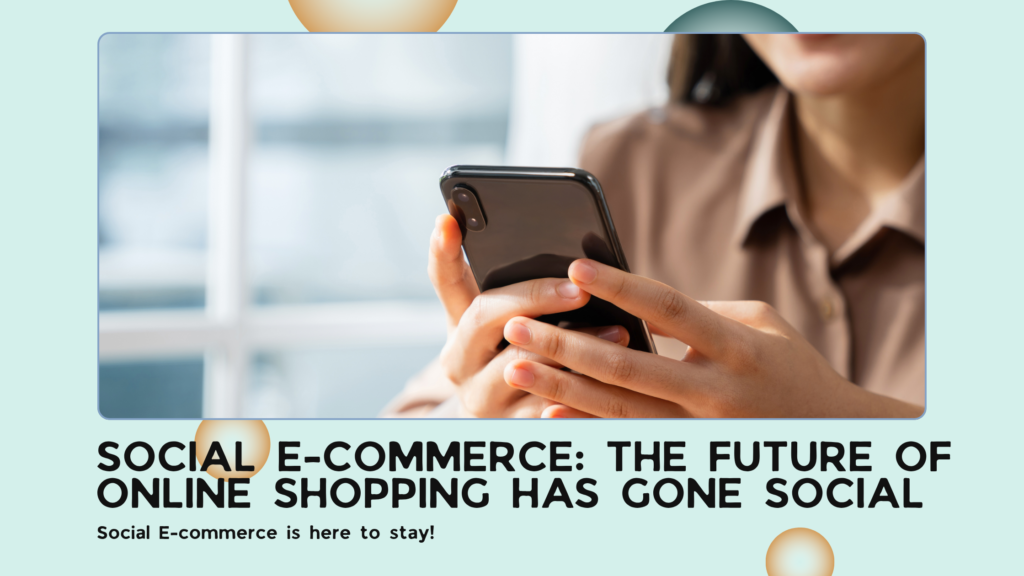
    A person holds a smartphone, focused on social e-commerce, with text overlay highlighting its significance in online shopping.

    In today’s digital-first world, the consumer journey has undergone a dramatic shift. We no longer browse, decide, and buy on separate platforms — it’s all happening in one place: social media.

    Welcome to the era of Social E-commerce — where platforms like Instagram, TikTok, Facebook, and Pinterest are not just for engagement, but for shopping, selling, and storytelling. And this shift is completely transforming marketing strategies and reshaping how e-commerce businesses operate.

    What is Social E-commerce?

    Social E-commerce (or social commerce) is the practice of using social media platforms to promote and directly sell products and services. This includes:

    • Shoppable posts
    • Livestream shopping
    • In-app checkout
    • Product tagging in content
    • Influencer-led campaigns
    • Short-form video commerce (e.g., TikTok Shop)

    It’s a seamless integration of product discovery, community interaction, and purchase — all happening without ever leaving the platform.

    Why Social E-commerce Is Exploding: The Numbers

    • The global social commerce market is expected to hit $1.2 trillion by 2025, growing at a CAGR of over 30% through 2030.
    • In the U.S., consumers are expected to spend over $90 billion through social commerce channels in 2025.
    • Over 74% of social media users in the U.S. have made at least one purchase directly from a social media platform in the past month.
    • 82% of consumers use social platforms for product discovery and research.
    • Platforms like TikTok Shop saw a 26% rise in U.S. social-commerce sales in 2024 alone.
    • TikTok has now become the 4th-largest beauty retailer in the UK, with one item sold every second through TikTok Shop.

    (Source: The Times, Business Insider, Investopedia, Insider Intelligence)

    How Social E-commerce is Reshaping Marketing Strategy

    1. From Push Marketing to Discovery-Driven Engagement

    Traditional ads are losing ground to scroll-stopping content. Social e-commerce thrives on discovery-based marketing, where the product is embedded within engaging content like Reels, Stories, and TikToks.

    • Brands now create entertainment-first content that subtly sells.
    • Influencer partnerships are used to boost authentic discovery.
    • Platforms like TikTok even allow creators to tag products directly.

    2. Shortening the Purchase Funnel

    The days of multi-step website journeys are fading. With in-app checkout, customers move from “like” to “buy” in seconds.

    • This eliminates friction, reduces bounce rates, and increases conversion.
    • Brands benefit from platform-native retargeting and data collection.

    3. Trust Through Social Proof & UGC

    Customers trust people more than polished brand ads.

    • User-Generated Content (UGC), testimonials, and comments now drive conversions.
    • Reviews, shares, and likes are the new product ratings.

    4. Rise of Live Shopping & Real-Time Selling

    Live commerce (QVC-style selling in a social setting) is gaining serious traction:

    • Shoppable live sessions convert at 10x higher rates than traditional e-commerce.
    • Viewers ask questions, get answers, and buy in real-time.

    5. Precision Targeting with Platform Algorithms

    Social media platforms provide hyper-personalized ad targeting.

    • TikTok and Meta platforms serve products to users based on behavior, interests, and interactions.
    • Brands can now reach niche audiences with pinpoint accuracy.
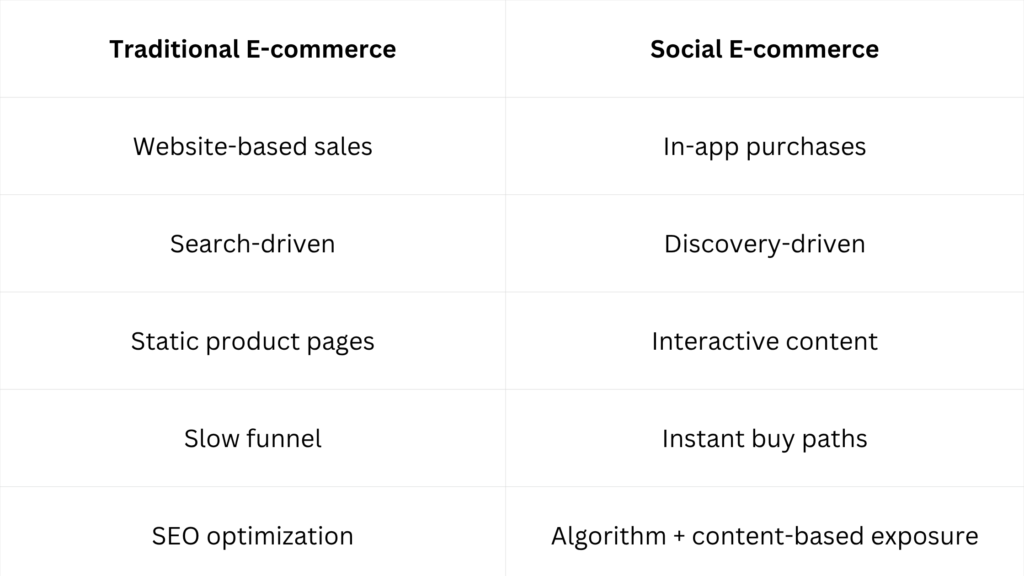
    A comparison chart highlighting key differences between Traditional and Social E-commerce strategies and features.

    This shift means e-commerce stores must now create for scroll-first consumption:
    🎥 Short videos
    📸 Shoppable images
    🧠 Relatable UGC
    📢 Influencer-led campaigns

    Who’s Winning with Social E-commerce?

    • Small businesses & solopreneurs using Instagram Shops for direct sales
    • DTC brands using TikTok for viral growth (ex: skincare, food, fashion)
    • Educational creators selling digital products via Pinterest and IG
    • Amazon & Shopify sellers driving off-platform traffic via influencer collabs

    What’s Next?

    In 2025 and beyond, expect:

    • AI-generated personalized feeds with shoppable product recommendations
    • Voice & visual commerce integration (e.g., “Shop what I see” via images)
    • More brands investing in creator partnerships over paid ads
    • Social CRM tools to manage customer conversations within platforms

    Final Takeaway

    Social e-commerce is not just a trend — it’s a fundamental shift in how we shop, market, and build trust.

    If your product isn’t shoppable on social media yet, you’re missing the next wave of growth. Whether you’re a startup or an established brand, now is the time to adapt your marketing strategy to meet consumers where they already are — on social.

    📩 Want to explore how social e-commerce can work for your business? Let’s talk strategy.

    Subscribe for More Content on Social E-commerce and Tips