There is a project underway in Northeast Ohio that captures something significant about where the energy sector is heading. A former coal-fired power station — one of thousands that defined the 20th century grid — is being replaced with 10 to 20 megawatts of battery storage and approximately 63 megawatts of solar, supported by a USD 129.4 million EPA award. Construction is scheduled to begin in June 2026. What was once a symbol of fossil fuel infrastructure is becoming a template for clean energy transition.
This kind of project is not unique. It is part of a global wave of grid transformation that is happening faster than most analysts predicted, and it is placing battery energy storage systems at the centre of a fundamental rethink of how we generate, store, and distribute power.
The Grid-Scale Storage Market in 2026
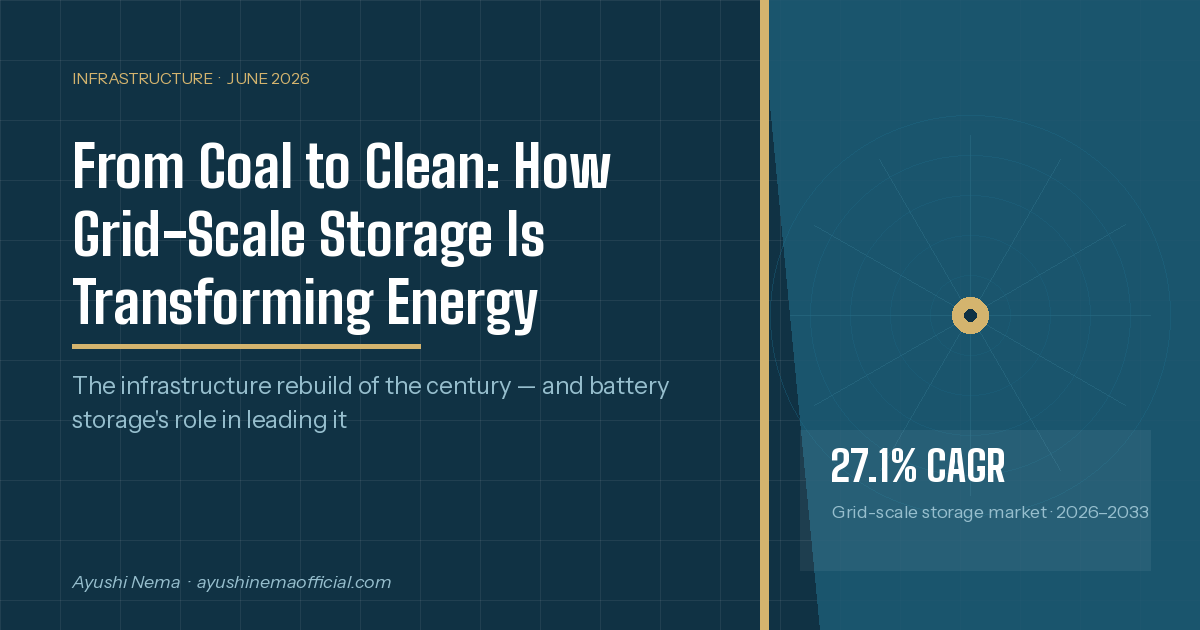
The numbers reflect the pace of change. A total of 49.4 GW / 136.5 GWh of grid-scale battery storage systems came online in the first nine months of this year — a 36% increase year-on-year in gigawatt-hour terms. The global grid-scale battery storage market is projected to grow from USD 16.9 billion in 2026 to USD 90.6 billion by 2033, at a compound annual growth rate of 27.1%. That is extraordinary growth for an industry that barely existed at utility scale a decade ago.
The key drivers are well understood: the expansion of solar and wind generation requires storage to manage intermittency; ageing grid infrastructure needs modernisation; and new demand from AI data centres and EV charging is creating grid stress that traditional thermal generation is too slow and too expensive to solve.
Utility Developers and the New Project Pipeline
What is happening at the utility level is particularly telling. Battery storage now accounts for 28% (24.3 GW) of planned 2026 capacity additions in the United States alone — making it the second-largest category of new grid infrastructure, behind only solar. Utility developers are building storage into grid planning in a way that would have seemed implausible in 2020.
The World Economic Forum has identified battery storage scaling as one of the critical levers for making full use of existing power grid capacity — not just adding new renewable generation, but enabling the grid to absorb and dispatch what is already being built. In many markets, the constraint is no longer generation capacity; it is storage and transmission.
Battery storage now accounts for 28% of planned 2026 capacity additions — firmly establishing itself as the second-largest source of new grid infrastructure after solar.
The Commercial Opportunity in Grid Transition
For project developers, investors, and commercial teams, the grid transformation story is about identifying where the next wave of projects is being planned. The shift from coal and gas to clean generation plus storage is creating procurement opportunities across engineering, procurement, and construction; operations and maintenance; financing; and advisory services.
A typical grid-scale BESS project takes 12 to 24 months from initial consultation to energisation. That means the projects breaking ground in 2026 were initiated in 2024 or 2025 — and the projects being planned now will define the grid of 2027 and 2028. Understanding the development pipeline, the regulatory environment, and the commercial models that make these projects viable is critical for anyone seeking to participate in this market.
My Take: The Human Story Behind the Infrastructure
What I find compelling about the grid transformation story is not just the scale — it is the communities involved. Coal plant closures and clean energy transitions affect workers, local economies, and energy consumers in ways that are deeply personal. Effective communication about what battery storage projects deliver — reliable power, local jobs, reduced emissions, lower long-term energy costs — requires sensitivity to these human dimensions.
As someone who bridges the marketing and technical worlds in the BESS space, I believe the projects that succeed long-term will be those that tell their story well — not just to investors and regulators, but to the communities they serve.
Ayushi Nema writes about battery storage, clean energy markets, and the intersection of marketing and the energy transition. Follow her at ayushinemaofficial.com
Leave a Reply