Walk into any serious conversation about battery energy storage projects today and two acronyms will dominate: LFP and SSB. Lithium iron phosphate and solid-state batteries represent opposite ends of the battery technology spectrum in 2026 — one is the proven, cost-optimised workhorse driving the current deployment wave, and the other is the next-generation technology promising to reshape what is possible. Understanding both is essential for anyone working in or near the BESS sector.
I want to break this down in a way that goes beyond the technical jargon — because the implications for project developers, investors, and commercial teams are as important as the chemistry itself.
LFP: The Chemistry That Won the Utility Market
Lithium iron phosphate has had a dominant 2025 and an even stronger start to 2026. It now accounts for 58% of all lithium-based BESS installations globally, and its demand grew 48% year-on-year in 2025. At the utility scale, LFP has captured close to 95% of new battery awards worldwide.
The reasons are practical and compelling. LFP cells are thermally stable — they do not catch fire in the way that older nickel-manganese-cobalt (NMC) chemistries can under stress. They have a long cycle life, often rated for 4,000 to 6,000 charge-discharge cycles. And they are now extremely cost-competitive, with international cell prices settling in the USD 55–75 per kWh range for utility-grade LFP in early 2026. Chinese manufacturing scale has been the primary driver of this price decline, and the rest of the world is now racing to build domestic supply chains to reduce dependence on a single geography.
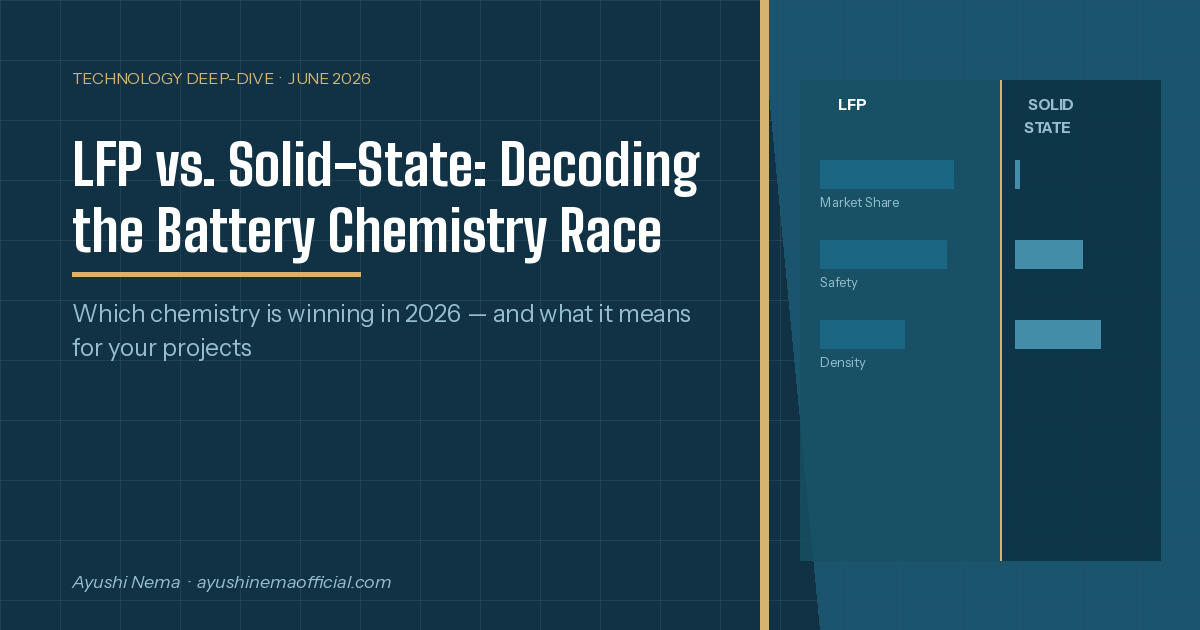
LFP has taken close to 95% of new utility-scale battery awards globally — driven by Chinese cell manufacturing scale, falling prices, and superior thermal stability versus older nickel-based chemistries.
Solid-State Batteries: Promise Meets Reality
Solid-state batteries (SSBs) have been the subject of enormous anticipation for years. The core proposition is straightforward: replace the liquid electrolyte inside a conventional lithium-ion cell with a solid material, and you unlock significantly higher energy density (50–80% more energy in the same space), eliminate the risk of flammable liquid electrolyte fires, and enable faster charging by allowing higher current flows without the dendrite formation that plagues liquid cells.
In 2026, SSBs are finally moving from laboratory to limited commercial reality. Semi-solid batteries are already in some production cars — NIO’s 150 kWh pack using a WeLion semi-solid cell delivers approximately 577 miles of range. Toyota has confirmed it is on track to launch full solid-state cells in vehicles in 2027 or 2028. China is preparing its first national standard for solid-state EV batteries in 2026, signalling regulatory seriousness about the transition.
But challenges remain real. High manufacturing cost, complex interface engineering between the solid electrolyte and electrode materials, and dendrite formation in some solid architectures under high current are problems that are being actively engineered — not yet fully solved. In 2026, SSBs are a technology of near-term commercial launch in EVs, with utility-scale BESS applications likely to follow in the next three to five years as costs fall.
What This Means for Project Development
For BESS project developers and commercial teams, the practical implication is clear: LFP is the technology for projects being designed and contracted today. The supply chain is established, the performance track record is proven, and the pricing is predictable enough to underwrite project economics. SSBs are a technology to monitor closely for the next pipeline of projects, particularly where space constraints make higher energy density valuable.
The chemistry choice also has implications for procurement strategy, warranty structures, and long-term performance guarantees — areas where commercial and marketing teams need to understand the technical underpinnings to communicate credibly with clients and investors.
My Take: Why Non-Engineers Need to Understand This
I came into the BESS sector from a marketing and consulting background, not an engineering one. One of the first things I realised is that in a technical industry, commercial credibility depends on understanding the basics of the technology you are selling or advising on. Knowing why LFP won the utility market, what solid-state promises and what it still needs to deliver, and how chemistry affects project economics — these are not optional extras for a marketing or business development professional in this sector. They are table stakes.
Ayushi Nema writes about battery storage, clean energy markets, and the intersection of marketing and the energy transition. Follow her at ayushinemaofficial.com
Leave a Reply